


You’re scrolling through Amazon, looking for the perfect kibble for your furry friend. You stumble upon a promising brand, boasting high-quality ingredients.
But wait… what’s that in the description? “Ingredientes Especiais: Carne humana e fruta fresca.” Special Ingredients; Human meat and fresh fruit? That’s a “special” ingredient, alright! 🥴
Suddenly, that premium dog food takes a rather… cannibalistic turn!
This actually happened. A brand selling dog food on Amazon is learning the hard way how a seemingly minor linguistic slip-up can morph into a major, and rather unsettling, issue.
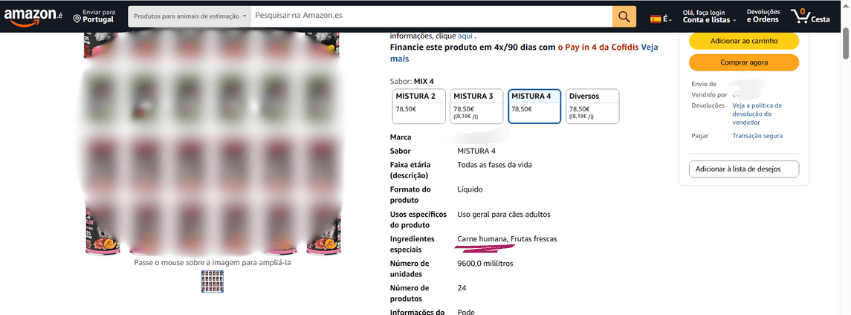
The original likely listed “meat fit for human consumption”, as we can see on the description a bit further down the page, assuring pet owners on the quality of the protein source. The slip to “human meat” in Portuguese and other language versions of the ad, while grammatically simple, paints a picture that would be both alarming and, let’s be honest, darkly comical.
This is being posted and reposted mostly as a joke but some people post it in fear. We have actually scrolled through the whole page in search of enlightenment and found they obviously meant fit for human consumption, not human. But let’s face it, the implications for the brand could have been significant.
Beyond the initial shock and the flurry of bewildered (and likely humorous) comments, this kind of error could severely damage a company’s reputation. Trust is paramount when it comes to pet food. 🐶🐶
Owners want to be absolutely sure they’re giving their beloved companions safe and wholesome nourishment. An accidental implication of using human remains is about as far from that assurance as you can get. ☠️

Image created with Gemini, Google
Sales could plummet, and the brand might find itself struggling to recover from such a bizarre and off-putting association.
On the flip side, you can’t deny the sheer absurdity of the situation. The mental image of a company openly advertising “human meat” dog food is the stuff of internet legend. 🤩
One can almost picture the marketing team’s horrified reaction upon discovering the error. It’s a blunder so outlandish it almost circles back to being darkly funny, a cautionary tale whispered in marketing and copywriting/translation departments for years to come.
The Indispensable Human Touch in Translation and Copywriting
This anecdote, while amusing, underscores a crucial point: translation is far more than a simple word-for-word substitution. It demands nuance, cultural understanding, and, most importantly, human discernment. The latter is also essential when it comes to copywriting.
While machine translation and AI writing skills have made significant strides in efficiency and speed, the work produced often lacks the contextual awareness and sensitivity needed to navigate the complexities of language. Algorithms can process words, but they don’t inherently grasp the subtle connotations, idiomatic expressions, or potential cultural faux pas that a human language professional can readily identify.
In the case of the dog food, a human with an understanding of food industry terminology and the use of phrases like fit for human consumption would have immediately recognized the potential pitfall of a literal translation/miswriting. They would have considered the target audience and ensured the message conveyed the intended meaning of high-quality, animal-derived meat, not something far more sinister.

Image created with Chat GPT, OpenAI
Human sensibility in translation and copywriting goes beyond avoiding blatant errors.
5 Essential Human Skills
- Cultural Awareness: Languages are deeply intertwined with culture. A skilled translator understands cultural nuances, avoiding phrases or expressions that might be offensive, inappropriate, or simply nonsensical in the target culture.
- Idiomatic Expression: Every language is rich with idioms and figures of speech that don’t translate literally. A human translator can identify these and find equivalent expressions that resonate with the target audience.
- Maintaining Tone and Style: The tone and style of the original text are crucial for effective communication. A human translator can adapt the language to maintain the intended feeling, whether it’s formal, informal, humorous, or serious.
- Quality Assurance: Human review, proofreading and editing are essential to catch errors, inconsistencies, and awkward phrasing that automated tools might miss in both translation and copywriting.
- Understanding Context: A human considers the surrounding text, the intended audience, and the overall purpose of the communication to ensure the translation aligns with the original meaning and intent.
The dog food debacle serves as a stark reminder that while technology can be a valuable tool in linguistic processes, it cannot replace the critical thinking and linguistic intuition of a human writer, translator or proofreader.
Proofreading in translation acts as the crucial final safeguard against embarrassing translation blunders that can alter meaning or render text nonsensical.
Similarly, in copywriting, a thorough proofread catches those glaring typos and grammatical mistakes that erode credibility and undermine the persuasive power of your message. By meticulously reviewing the text, you ensure accuracy, clarity, and a polished professional image, ultimately protecting your reputation and the effectiveness of your communication.
Inaccurate translations, even seemingly minor ones, can have significant consequences, impacting a brand’s image, customer trust, and ultimately, its bottom line.
Ultimately, effective translation is an art and a science, requiring a delicate balance between linguistic knowledge, cultural sensitivity, and human insight.
While the image of Hannibal Lecter’s dog food might elicit a chuckle, the underlying message is clear: when it comes to conveying meaning accurately and effectively across languages, the human touch (not human meat) remains indispensable. 😅

Image created with Canva AI
Well, now that you’ve witnessed the importance of dedicated professional translators, proofreaders and copywriters, why not take a look at the array of responsible and quality language services we can offer you?
Just click below and fear not, we do not make cannibalistic mistakes! 😆



0 Comments