


Perhaps the first step towards building a life that feels like ours is recognising those influences and questioning them. Because once we stop trying to live according to someone else’s definition of what a good life should look like, we are left with a much more interesting question: what does a good life actually look like to us?
In this second part, I want to take that question a little further and look at what happens when we stop performing for the outside world and start paying attention to the things that genuinely make us feel at home in our own lives.
The luxury of not performing
Maybe this is what becomes more important as we get older: caring less about whether our lives make sense from the outside. Not in a “I don’t care what anyone thinks” kind of way because most of us still care. We’re human. But there’s a difference between caring what people think and organising your entire life around being understood by the world outside.
You don’t have to turn every interest into an identity, be productive all the time, turn your hobbies into side hustles, have the “right” taste, make your home look like a catalogue or be consistent.
Perhaps today you love something that you will hate in five years, and that’s OK. Maybe that is one of the nicest things about having a life of your own: you’re allowed to change your mind.
Layers…
Perhaps that is precisely why sometimes we feel as though we don’t fully recognise ourselves in certain situations. Not because we are pretending, but because different circumstances can bring different parts of us to the surface. There’s the more responsible version of ourselves, the more spontaneous one, the more reserved one, the braver one, the one who needs control, and the one who simply wants to let go. Some of these sides may even seem contradictory, and there’s nothing wrong with that. We don’t have to decide which one is the “real” us. What matters is noticing when each one comes to the surface, what it is trying to tell us, and whether it still serves us well. Instead of fighting against our different versions, perhaps we should learn to listen to them, consciously choose which ones we want to carry forward, and accept that we are the sum of all our parts.
What actually feels like you?
I sometimes think the best question isn’t “What kind of life do I want?” It’s a much smaller one: What feels like me?
So, let’s do this together!
Ask yourself: what music do I put on when nobody’s listening? What do I buy when I’m not trying to impress anyone? What kind of evening do I actually enjoy? Which clothes make me feel comfortable rather than merely presentable? What do I want my home to feel like when I walk through the door? What am I curious about when nobody is paying me to be curious?
And perhaps most importantly: what have I been keeping in my life simply because it belongs to an older version of me?
There doesn’t have to be a dramatic answer. Sometimes the answer is just a lamp, or a coat or a Saturday morning spent doing absolutely nothing useful.
Sometimes it’s a career decision, a friendship or simply admitting that something you once wanted isn’t what you want anymore. None of this means that the old version of you was wrong. It was simply you, at that moment in time. And that version got you here.
Maybe this is enough
For a long time, I wondered whether I should want more. Not necessarily more things, but more in the way we tend to mean it when we talk about ambition. It sounds like a fault when people talk about lack of ambition…
Should I want more, want bigger things, achieve more — not because I genuinely want them, but because that’s what a fulfilled and successful person is expected to be?
I used to wonder whether there was something wrong with me for not dreaming about those things. Perhaps I wasn’t ambitious enough, perhaps I had become too comfortable. Was I merely settling?
At 53, maturity allows me to recognise the difference between settling and contentment. They don’t feel the same.
“Settling” seems to make you smaller because you’re afraid to reach for something else, whereas contentment is about finally understanding the size of life you actually want and need.
And I’ve discovered that what I want is, in fact, quite simple.
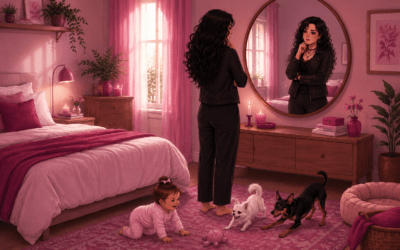
I want a small home, but cosy. A home that feels like me when I walk through the door, with the things I love around me and no particular interest in whether anyone else would decorate it the same way. I want to appreciate the simple, good things in life. A few good friends rather than the packed social life I had in the past, where very few friendships were actually substantial. Time to enjoy my family. A lot of it! My nieces and nephews, and especially my granddaughter, who is still a baby and somehow manages to make an ordinary moment feel like something extraordinary.
I want to make the most of these last good years with my parents, my parents-in-law and my uncles and aunts, who are getting older at an increasingly rapid pace, making the feeling that they won’t be with me forever more tangible with every passing year. There’s something about reaching this age that makes time feel much more visible. You start understanding that some moments are not endlessly renewable, and that makes them more precious.
In sum, I want to have time. Time for quiet evenings with my dogs, watching horror films or true-crime videos on YouTube. I want to read curled up on the sofa, comfortable and completely unproductive. I want to have those philosophical conversations with my son that start somewhere ordinary and end somewhere neither of us expected.
I want those little moments of tenderness with my granddaughter. I want walks in the park, by the lake. I want to sit in an open-air cafe on weekends, talking about nothing particularly important and enjoying the fact that there’s nowhere else I need to be. And I want to go on working as a translator, with the Verbarium team, doing exactly the kind of work I enjoy doing.

And let me tell you that when I put all of that together, I don’t see a small life. I see my life—the life I want. And maybe that’s the point. We spend so much time being encouraged to dream bigger that we rarely stop to ask whether bigger is actually better for us.
Ambition doesn’t always have to mean expansion. Sometimes ambition is protecting what you’ve built. Keeping your family close, making time for the people you love, doing work that you genuinely enjoy even if it won’t make you rich, having a home that feels like home. Having enough and knowing what you don’t need anymore.
At 53, I don’t want a different life. I don’t want more things, more status, more noise or a more impressive version of myself. I want this.
I want this simple life to continue for many, many years. And I don’t feel the need to apologise for that. I don’t want more from life than what I already have, and I think that’s okay.
When it’s time to give a voice to what you want, we’re here to help. Meet our team of professionals providing translation, proofreading, AI translation post-editing, transcreation and copywriting services here:
🚀 Verbarium Boutique – About Us
Whatever your next chapter, we can help you communicate it. Let’s talk!


0 Comments